for Small Businesses
When running a small business, every investment decision—whether it’s purchasing new equipment, opening a new location, or launching a new product—requires careful evaluation. One of the most effective ways to assess whether an investment is worth making is by using Net Present Value (NPV). This financial metric helps determine whether a project will create or destroy value for the business.
1. What is NPV and Why is it Important?
NPV measures the profitability of an investment by comparing the present value of expected future cash flows to the initial investment. In simple terms, it tells you how much value an investment will add to your business, considering the time value of money.
Why is NPV the most important metric?
- Considers Time Value of Money (TVM): Money today is worth more than the same amount in the future due to potential earnings.
- Accounts for Risk: The discount rate in NPV reflects the risk of the investment.
- Provides a Direct Value Assessment: Unlike other metrics like Payback Period or Internal Rate of Return (IRR), NPV provides a clear monetary value, making decision-making easier.
2. How to Calculate NPV for a Project
NPV is calculated using the following formula:
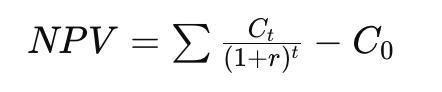
Where:
- (Ct) = Cash inflows in each period (e.g., revenue, cost savings)
- (r) = Discount rate (cost of capital or required return)
- (t) = Time period (years, months, etc.)
- (C0) = Initial investment cost
Step-by-Step Calculation:
- Estimate Future Cash Flows: Project how much cash the investment will generate each year.
- Determine the Discount Rate: Typically, the cost of capital or the expected return on alternative investments.
- Apply the NPV Formula: Discount future cash flows to their present value and sum them up.
- Subtract the Initial Investment: This gives the final NPV.
3. Key Assumptions in NPV Calculation
Several assumptions go into calculating NPV, including:
- Cash Flow Estimates: Future cash inflows and outflows are projections based on market demand, operational efficiency, and other factors.
- Discount Rate Selection: Choosing the right discount rate (typically the weighted average cost of capital, WACC) is crucial.
- Project Lifespan: The estimated duration for which cash flows will be generated.
- Residual Value: The potential resale value of assets at the end of the project.
- Market Conditions & Risk: Inflation, competition, and external risks can affect actual returns.
4. Making Go/No-Go Decisions Using NPV
The rule for decision-making is straightforward:
- If NPV > 0: The project is expected to add value to the business. Go ahead.
- If NPV < 0: The project will destroy value. Do not proceed.
- If NPV = 0: The project neither gains nor loses value. Consider other qualitative factors before deciding.
Conclusion
NPV is a powerful tool for making investment decisions in small businesses. By carefully estimating cash flows, selecting an appropriate discount rate, and understanding key assumptions, business owners can make informed decisions that maximize profitability and minimize financial risks. While no financial model is perfect, using NPV ensures a structured approach to evaluating investment opportunities and driving long-term business success.
 The Simple Ideas Blog
Leave a comment